GlobalWorx
DSD industry's leading communcation Platform
Role: Sr. UX Designer, Design Lead
Year: 2024-2025
Introduction
Overview
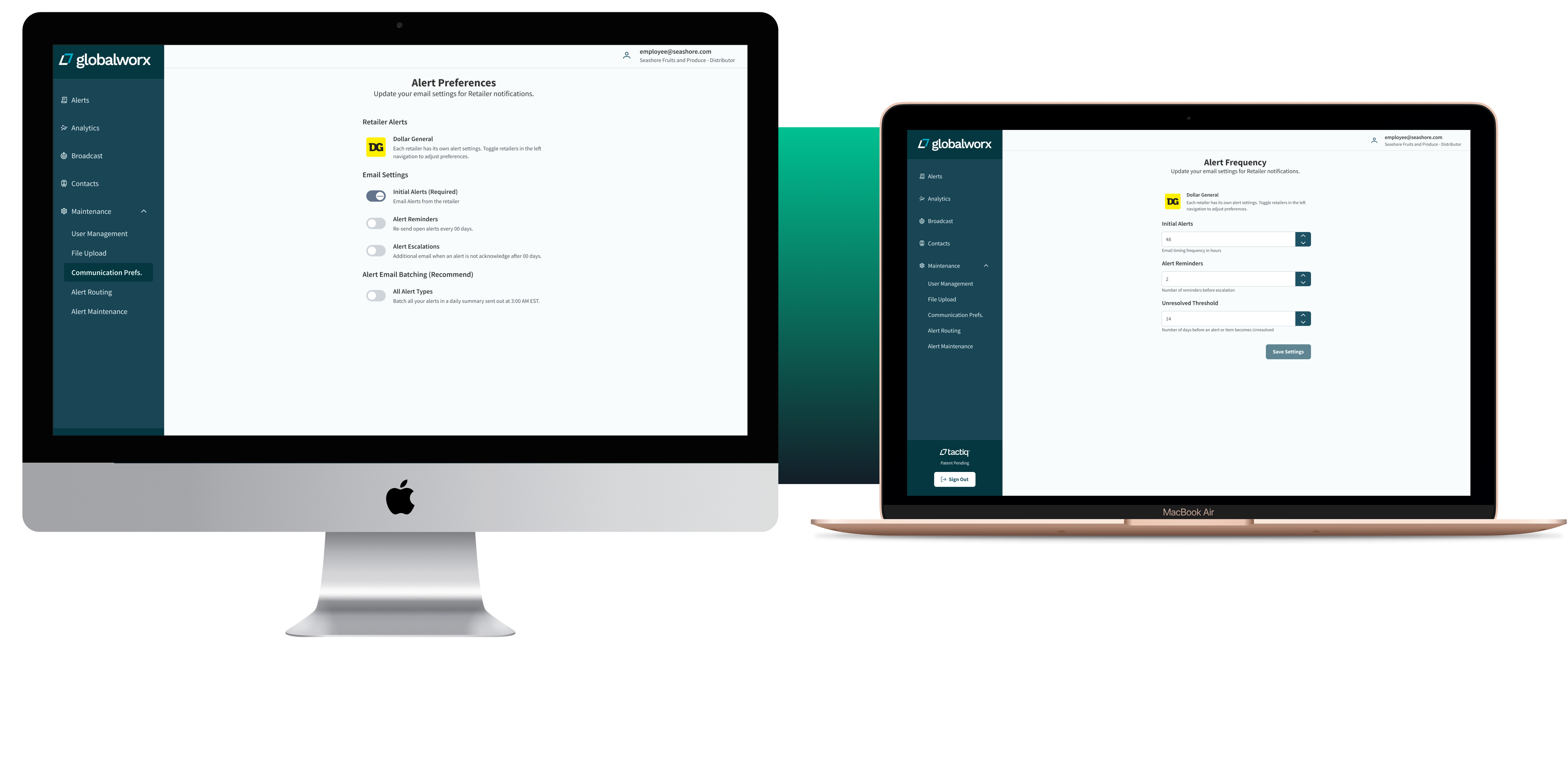
GlobalWorx is an advanced communication and execution platform designed to optimize on-shelf availability for Direct Store Delivery (DSD) products. As the evolution of Pipeline 2.0, it enables real-time issue reporting, automated ticketing, and vendor communication to ensure faster replenishment and reduce out-of-stock occurrences.
With integrated workflow automation, analytics, and a modular design system, GlobalWorx strengthens collaboration between retailers and distributors, improves supply chain visibility, and ultimately drives sales by keeping products consistently available at the shelf.
Tactiq
Tactiq is a leading provider of DSD solutions with over 20 years of experience serving retailers, distributors, and manufacturers. Their focus is on streamlining supply chains, enhancing communication, and improving operational efficiency across the retail sector through innovative, data-driven tools.
The Acquisition
In Q2 2024, Tactiq acquired GlobalWorx, an indirect competitor in the DSD technology space. This acquisition expanded Tactiq’s customer base to include major retailers such as Kroger, ADUSA, and Target, significantly increasing scale and complexity.
Following the acquisition, Tactiq made a strategic decision to sunset its legacy platforms (Pipeline 2.0 and Legacy GlobalWorx) and merge them into one unified system under the GlobalWorx brand. The goal was to design and build a scalable, modern, and configurable platform that not only bridged both product lineages but also exceeded the technical, usability, and scalability expectations of enterprise DSD customers.
The Problem
Tactiq's Pipeline 2.0
Pipeline 2.0 thrived in small-format retail operations, offering strong performance in convenience and specialty store channels. However, it struggled to scale to large-format retailers due to architectural and infrastructure limitations.
- Infrastructure barrier: Hosted on AWS, which many large grocery retailers avoided due to competitive conflicts with Amazon (owner of Whole Foods).
- Feature limitation: Not designed for multi-store or multi-department operations common in large retail environments.
- Integration gaps: Unable to support modern API-driven workflows or large-scale data ingestion.
These limitations prevented Pipeline from onboarding new enterprise clients post-acquisition and made modernization essential.
Legacy GlobalWorx
The legacy GlobalWorx platform was built on outdated technology with a fragmented architecture and limited UX maturity. Over time, rapid patchwork development and a lack of design oversight led to inconsistent experiences, redundant workflows, and frustrated users.
Customer surveys revealed:
- Low satisfaction with usability and speed
- Poor visibility into ticket progress and resolution
- Lack of scalability for growing retail networks
Early audits confirmed that a ground-up rebuild was the only viable solution to unify the two systems and deliver a next-generation experience.
Research & Discovery
Approach
Our research combined internal audits, stakeholder interviews, and user feedback from both legacy platforms. Drawing from our direct experience designing Pipeline, we mapped strengths, weaknesses, and overlapping features to identify opportunities for consolidation and innovation.
We partnered with product managers, developers, and customer success teams to collect insights from retailers, distributors, and field reps. This user-centered approach ensured that every design decision was backed by real operational context and business value.
Methodologies
- Platform audits: Feature and workflow comparison across both systems.
- User interviews: Deep dives with DSD reps, store managers, and vendor partners.
- Journey mapping: Visualization of critical flows such as scanning, ticketing, and communication.
- Surveys & analytics: Measurement of user satisfaction, completion rates, and performance bottlenecks.
Goals
- Evolve the Product Ecosystem
Design a next-generation platform that expands on the best of both products while removing technical and UX debt. The new GlobalWorx needed to scale across retailer sizes, configurations, and roles with modular architecture and flexible UI frameworks. - Optimize Item Scanning and Execution
Scanning was a signature feature of Pipeline. We reimagined it as a universal plug-and-play module compatible with camera-based mobile scanning and third-party devices. The goal was to reduce dependency on proprietary Zebra hardware, introduce smarter grouping logic, and integrate out-of-stock image capture and notes for faster issue resolution. - Standardize DSD Communications
Unify fragmented communication channels used across different retailers into a single standardized workflow. By aligning ticketing, messaging, and notifications, we reduced friction between stores, distributors, and manufacturers while improving transparency and accountability. - Embed Human-Centered Design
Prioritize simplicity, clarity, and consistency across every touchpoint. Each feature was validated through iterative testing to ensure it met real user needs, reduced complexity, and aligned with Tactiq’s larger design system for scalability.

Implementation Challenges
Navigating Strategic Product Evolution
The biggest challenge was balancing legacy expectations with future ambition. We had to combine two established products, each with strong user bases, into a cohesive, forward-looking experience.
This required:
- Reframing the design process from incremental fixes to full-scale reimagination.
- Building alignment between multiple stakeholder groups and technical teams.
- Creating design systems and modular components flexible enough to serve both small and large retailers.
Through collaborative workshops, cross-functional design reviews, and iterative prototyping, we guided the product evolution from two fragmented tools into one modern, scalable, and user-friendly platform.
Conclusion
Outcome
The redesigned GlobalWorx platform became the central hub for DSD communication and issue resolution. It unified data, streamlined workflows, and introduced modern design standards that significantly improved usability and adoption.
Key Results
- Fully merged legacy user bases under one scalable platform
- Reduced average ticket resolution time through real-time communication and automation
- Improved adoption rates among field reps and retail managers due to simplified UI and mobile scanning
- Established a reusable design system and component library for future Tactiq products
The result was not just a redesign but a complete transformation of how retailers and distributors collaborate to maintain on-shelf availability across the DSD ecosystem.
Summary
GlobalWorx redefined the DSD industry’s approach to communication and execution. By merging technology, human-centered design, and workflow automation, we built a scalable platform that helps retailers and distributors work smarter, act faster, and keep products where they belong — on the shelf.